Showing posts with label Reviews. Show all posts

Urban Explorer (2011)

Nazi-themed horror seems to be in fashion at the moment, which is probably why there’s a swastika on the UK DVD cover of Urban Explorer, since the film doesn’t really have anything to do with the Nazis.

It starts out promisingly: a group of strangers pay a tour guide to take them on a tour of the abandoned underground network beneath Berlin. Apparently, somewhere deep below the city is a forgotten Nazi bunker, which was recently rediscovered and then bricked up again to prevent neo Nazis gathering there; but when the intrepid explorers venture below ground, they quickly run into some violent creeps who very well might be neo Nazis.

Spoiler alert: they aren’t. They’re just one of the many, many red herrings this absurd piece of sub-Hostel nonsense has to offer.

As is traditional in this sort of horror movie, the victims soon make a succession of bad ideas – straying into parts of the underground that haven’t been properly explored before, building makeshift bridges out of debris – putting themselves in danger. After one spectacularly stupid move on the part of the group’s photographer, the group is forced to split up to seek help, and, naturally, soon fall prey to the monster lurking in the shadows. Despite the tour guide’s fanciful campfire stories of Nazi piano-playing and super-soldiers, the actual threat turns out to be much more recent: an ex-military psychopath who relished his border guard duties so much that he continues to enforce them from a drug-filled bunker in the bowels of the earth. It could almost, maybe, work as a concept… unless you stopped to think about it for a second.

In the utter absence of logic, then, what Urban Explorer delivers instead is some very nasty gore. It starts out pretty tame, and there’s a scene that appears to have been directly lifted from Hostel, but it builds to one particularly nasty scene that is, at least, reasonably original, and deeply unpleasant. You’ll need a strong stomach to get through it. That’s the only glimmer of originality to be found in this film, though, and its extreme gore sits oddly alongside its occasional moments of pure slapstick. All your standard horror movie tropes crop up, including the botched calls for help, the lack of cell phone signal, and the killer who’s never quite dead no matter how many bullets you put in him. It’s a frustrating mess that spoils itself by promising something interesting and then backing off, lapsing into cliche and boredom.

Apart from frustration, though, the main feeling this film provokes is déjà vu. We’ve seen spooky underground spaces lit by flares in The Descent; we’ve seen those dirty, dimly lit rooms full of torture instruments in Hostel; and we’ve even seen someone fall down a shaft and break their legs in The Ruins. It feels like this film should’ve come out five years ago; now, it seems a bit anachronistic. And while most horror movies are derivative in one way or another (and if you’re going to borrow from other films, you’re better off borrowing from half-decent ones!) it really does feel like this one doesn’t have anything new to offer.

Which is a shame, because if it’d delivered the winged Nazi super-soldier it suggested in its first half hour, it could’ve been amazing. But no. Most of the things that are set up at the beginning fail to pay off: there’s no Nazi element to the murders or the murderer; the piano doesn’t come back into play; even the creeps lurking in the underground don’t have any bearing on what happens later. In a better film, this might feel like deliberate misdirection; here, it just feels like carelessness. The sort of complaints that can be levelled at Urban Explorer – that it doesn’t quite make sense, that the characters have no depth, that the gore is purely sadistic and serves no greater purpose – are the same complaints that have been made of many other, better films over the past decade; it’s just kind of boring.

One final minor gripe, too: the young explorers are all different nationalities, which could be interesting, but only really means they each have a different accent. Most of the dialogue is in English, but it’s so heavily accented that it’s frequently difficult to understand, so it’s a relief every time the film lapses into (subtitled) German. Given that none of the group has a discernible personality, there doesn’t seem much point to their differing geographical backgrounds, other than making the (not particularly sparkling) dialogue that much harder to follow.

Basically, this is another one for the “why bother?” file. There’s some nice photography in the first reel, and the location is intriguing, but beyond that there’s absolutely nothing to recommend it.

IMDB link

Wake Wood (2011)

I really don't enjoy hating new, low budget, British horror films. I'd love to champion Wake Wood and tell you how brilliant it is. But I can't, because it's awful - in an oh-God-I'd-rather-peel-my-face-off-than-keep-watching-this kind of a way.

The Wake Wood of the title is actually Wakewood, a small town in Ireland that's got some serious idiosyncracies. Bereaved parents Patrick and Louise move in after their young daughter is tragically killed by a dog, and are quickly offered the traditional monkey's paw: by using the remains of a recently deceased townsperson, they can conjure just enough life force to bring Alice back to life for three days.

This is, apparently, something all the townsfolk do whenever someone dies, and despite the obvious Pet Sematary parallel, it's usually totally okay. There are rules, though: the person to be resurrected must have been dead for less than a year, and during their three days they mustn't cross the town's boundaries. After their three days are up, too, Patrick and Louise will be bound to the town, and must never move away. You'd think warning bells would be ringing already, but the promise of seeing their daughter again is too much, and the couple go ahead with the ritual, using the corpse of a farmer who was recently crushed to death by a cow.

Something's off about Wake Wood from the beginning. Partly it's the ugly way it's filmed; it looks like it's been filmed on an iPhone and then passed through half a dozen filters in an attempt to make it look cinematic. Partly it's the awkward dialogue, and the way characters seem to react as if they can't quite hear each other. Mostly, though, it's the strange way it feels like this wasn't written as a movie. The death-by-cow is a prime example - it looks faintly ridiculous seeing a man squished between a cow's backside and a metal gate, but it feels like it was an idea that might have worked in print. There's a discrepancy between the way the film's been shot and acted - trying to wring every last drop of pathos out of Alice's admittedly tragic death and her parents' subsequent grief, for example - and the inherent campiness of the script. Some of the characters' stranger decisions would make more sense if the world they inhabited was less familiar-looking; if they were in a slightly more stylised, gothic universe, it might be easier to accept that, yeah, there's this whole community who can resurrect their dead people for three days at a go, and they've been doing it for generations, and it's all cool. As it is, it's tough to swallow that any rational adult could buy into this, and the film doesn't seek to address any of the issues built into a system like that before everything goes horribly wrong.

Which of course it does, because Patrick and Louise break both of the fundamental rules of this game: not only do they take Alice outside of the town's limits, but she had been dead for over a year in the first place, which means she came back wrong. Yup, we're back in creepy little girl territory: Alice starts by murdering animals and quickly moves on to killing people and generally being a terror. Why? God knows. Somehow, in the three or four extra weeks she'd been dead, something terrible happened. (It's difficult to know the exact chronology, because the beginning of the film is intentionally muddled to prevent you from figuring out that Alice had been dead too long; actually, what this muddle does it make it really difficult to understand quite what's going on for a while, because although Patrick and Louise are supposed to be outsiders in Wakewood, just learning about its weird traditions, we've seen them both working in jobs that are pretty well embedded in the community.)

There's a logical and emotional leap that the film makes that leaves its audience behind; when Alice comes back, her parents seem to revert to their normal, happy, pre-dead-child state, ignoring the fact that they've only really got three days with her. I mean, if your child had been killed by a stray animal while you weren't around, and then you got to spend just three more days with her alive, would you really want to go playing hide and seek in the woods? There's no sense of urgency to their interactions with her; they're desperate to have her back and then, when she is back, seem to forget what's going on, not finding it in the least bit strange that she's come back with someone else's eye colour or that she frequently disappears only to come back with bloodstained hands.

The film ends with one of the most stupid - and yet painfully obvious - scenes ever committed to celluloid (or digital video; whatever). By this point, though, it almost doesn't matter. Wake Wood is terrible through and through. It wants to be a cross between The Wicker Man and Don't Look Now, but can't manage it, resorting instead to heavy-handed references to both. Where those films had emotional resonance - or, at least, gorgeous photography - Wake Wood has a daft scene with a cow and a magic town of rural stereotypes. If the new Hammer Films can't do better than this, they might as well give up.

My Soul To Take (2011)

Dissociative identity disorder, or multiple personality disorder, is a controversial condition: it seems that it's linked with traumatic events in a patient's life; it doesn't have easily definable symptoms; and according to some clinicians, it might actually be caused by the therapists themselves. So what better topic to make a terrible, dull, confused slasher movie about?

My Soul To Take is not a clever film. It starts, as all slashers must, with a bit of backstory: a man, Abel Plankov, is working on toys for his young daughter when his pregnant wife interrupts and says that the news is scaring her with its reports of the Riverton Ripper, a local serial killer. In the background, a psychiatrist named William Blake - and I'm going to pretend I didn't notice that, because, ugh - tells the news reporter that the killer might be suffering from mental illness, and might not even be aware that he's the killer. Surprise! It turns out Plankov is the killer - or, at least, one of his other personalities is. He calls Blake with his worries, but it's too late, and he kills his wife before the police arrive. And then he kills some of the police. They shoot him, but like all slasher movie villains he's not going down that easily. Even when they get his corpse into an ambulance, it's not over; the ambulance crashes into the river, and we fast-forward 16 years.

On the night Plankov supposedly died, something strange happened in the maternity ward. Pregnant women spontaneously went into birth, even when they weren't due, and seven babies were born that night. Improbably, a legend sprang up around them: that Plankov's personalities were in fact separate souls, which had passed into the babies. Every year, on the anniversary of his death, the seven kids gather at the scene of the ambulance crash and carry out a bizarre ritual that involves someone dressing up in a "Ripper" costume (which bears no resemblance to anything, but you've gotta have a mask in films like this) and being symbolically "killed". Apparently, this ritual will stop the Ripper from rising again, but this year, it's interrupted by the police. And so the killing starts again.

There's a ton of extra symbolism thrown in haphazardly: lots of stuff about mirrors, and a Native American myth about the condor being a bird that can absorb souls, but even that can't save the majority of the film from becoming a dull exercise in watching daft teenagers get butchered. The dialogue is embarrassingly bad, and the plot is convoluted without ever actually being interesting. It's obvious what's going to happen, and even the identity of the killer isn't really a surprise. There's no reason for the audience to become invested in any of the characters, there's no real tension at any point, and the ending is just too stupid for words. The idea that someone with a mental illness might be possessed is horribly outdated, offensive, and amateurish; there's just no excuse for falling back on that ugly trope in 2011.

Worse, the movie was shot in 2D, then converted to 3D for its theatrical release, which is the only way to make something this stupid even more painful.

Season of the Witch (2011)

Nicolas Cage is capable of making brilliant films. Last year's Bad Lieutenant: Port of Call - New Orleans was magnificent, and Kick-Ass was great, too, so it's not like he's given up on trying to make good movies. But he seems to be bizarrely determined to destroy any goodwill generated by those performances by appearing in crap like Season of the Witch. It's frustrating.

Season of the Witch lays its cards on the table early. We open on a witch trial, where three women are found guilty of witchcraft by virtue of, basically, being female, and are promptly killed. For a moment, it looks like the film might be condemning their prosecutors for their cruelty, but then - aha! - it turns out the women really were witches after all, and through the power of shitty CGI they come back to life to claim their revenge. The film immediately marks itself out as stupid, ugly, and deeply offensive, all before Cage even appears onscreen.

But it doesn't get any better when he does. Cage plays Behmen, a seasoned soldier in the Crusades who suddenly decides he doesn't want to kill any more people. He and his best mate Felson (played by Ron Perlman) become deserters, riding round half the world on their trusty horses before arriving at a creepy-looking town where everyone's dying of the plague. Because no-one understood germs back then, they hang around until a member of the clergy spots them and has them thrown into jail. They're offered only one way out: the Cardinal believes that the plague was caused by a witch, and the only way to cure it is to take the witch to a monastery miles away, where the monks have a special plague-curing witch-killing book of some kind.

It's all a very, very complicated way of setting up a quest, basically: Behmen and Felson, along with a ragtag assortment of untrustworthy locals, must accompany a young girl who may or may not be a witch through a series of Tolkien-esque obstacles to get to Mordor, where the monks will use their magic ring to cure the plague. Or something.

Already, the script is being pulled in a number of different directions. Behmen is apparently the hero, even though we know he's massacred hundreds of people, so we're supposed to invest in him and share his disapproval of the Catholic church and its methods. The Cardinal certainly doesn't appear to be a sympathetic figure, and there's something suspicious about the priest who goes along on the mission; it's implied that he's been mistreating the girl/witch, possibly sexually abusing her. The Church is wrong about the Crusades, and since we, the audience, know that the plague wasn't caused by witches, we think they're wrong about that, too, and logically should assume that the girl is innocent. Except that we've just seen that this is a film in which magic and witchcraft exist, because we just saw an old woman come back to life.

Season of the Witch can't seem to make up its mind whether it wants to be a serious movie about the ways in which religion can lead people to do awful things to each other, or whether it wants to be a swords 'n' sorcery style epic about brave men fighting monsters. That first scene kills all the film's attempts at ambiguity, and renders them merely confusing instead. Any attempts to build dramatic attention are skewered by that first scene; we know the girl's going to turn out to be a supernatural entity, otherwise the first appearance of a CGI witch doesn't make any sense.

But the film's too stupid to realise that it has already shown its hand. Its wobbly internal logic collapses completely when the travellers arrive at the monastery to find that all the monks have died of the plague. And when the priest tries to exorcise the witch using the Big Book of MacGuffin, two entirely separate endings attempt to happen at once: the girl initially starts speaking out against the cruelties of the Catholic church, and then reveals herself to be a demon. There's a possibility the film could resolve its problems by making her a demon that's come to punish the Church for its sins, in a be-careful-what-you-wish-for kind of a way, but it doesn't even do that. No, instead, it turns out that the girl has been possessed by a devil the whole time, and the trek to the monastery was so that it could kill the monks and destroy all the remaining copies of the magic book that could defeat it. The demon takes on its true form - a bat-like gargoyle thing - and starts killing everyone in the hope the audience won't notice that none of that makes any sense: why would the demon need anyone to transport it anywhere, if it had wings? Why would it need to go to the monastery to kill everyone when they were all already dead from the plague? Why bother with the whole 'witch' disguise in the first place? And why kill so many of its entourage along the way if what it wanted was for them to take it to the monastery? Either this is the stupidest demon ever committed to celluloid, or someone started rewriting this movie halfway through.

To add one final insult to injury, when the battle is finally over, the vanquished demon turns back into a girl - so apparently it was a demon possessing a girl, rather than a demon disguised as a girl - who's completely innocent and remembers none of what happened. As she and her one remaining knight ride off into the sunset, there's a voiceover in which she tells us she wants to tell the story of all the brave men who died to rescue her. Except that they didn't, they were trying to kill her, and she just said, right in that scene, that she doesn't remember anything that happened. It's like there are two, or maybe three or four, movies running simultaneously here, and all of them are terrible.

Without Nicolas Cage, this movie would never have seen the inside of a cinema. There isn't a single part of it that's well-made, and its stupidity is offensive. Hundreds of women really have been murdered throughout the ages because someone accused them of being witches. None of them were actually demons. The Crusades actually happened, and people really got killed. Making a film in which all of it comes down to a giant CGI bat is about as insensitive as you can get.

IMDB link

Let Me In (2010)

Not all vampires live in castles. Since Dracula’s day, vampires have had to downsize significantly: but while Louis and Lestat might’ve had a gorgeous big house in New Orleans, Let Me In’s Abby has to make do with a poky flat in a suburb of a small New Mexico town. The walls are so thin that her neighbours can hear every time she raises her voice, and the windows are covered over with cardboard. Even a thick blanket of snow can’t make her Los Alamos home look anything other than rundown and dreary.

Let Me In is a wonderfully real vampire story, based – of course – on Swedish novel, and film of the same title, Let The Right One In. As remakes of foreign horror movies go, it’s by far the best. In fact, it might even be superior to the much loved Swedish film (though suggesting that is regarded as blasphemy in some circles!). Let Me In pares the story down to its most essential elements, disposing of almost all of the subplots and extraneous characters that populated the world of the novel and focusing right in on the main relationship of the story: the weird love affair that blossoms between vampiric Abby and her next-door neighbour, a sad, bullied 12-year-old called Owen.

Owen’s life is, basically, miserable. His parents are getting divorced: his father is absent, and his mother isn’t much better. (To the point where we never quite see her face in the film, and only hear his dad’s voice over the phone.) He’s bad at sports, addicted to sweets, and mercilessly bullied by a gang of boys at school – to the point where he takes up afterschool strength training in a hopeless effort to stand up to them. When a mysterious family move in next door, he’s determined to make friends with the girl, despite her warnings. They bond over, um, a Rubix cube, and the lack of anyone else to talk to, and she encourages him to stand up to the bullies. But as they grow closer, Owen discovers that Abby really is strange: she doesn’t feel the cold, sometimes smells funny, and turns into a monster when he attempts a blood-bonding ceremony with her. Ultimately, though, she’s the only one who seems to understand him (or even pay him attention that doesn’t involve beating him up) and he becomes fiercely loyal to her, even as the body count starts to rack up.

The novel is littered with subplots and background characters: there are the town drunks, two of whom are repurposed in Let Me In as Virginia and her boyfriend, though they get have a much smaller role to play here; there’s Oskar’s neighbour, Tommy, who only gets a passing mention this time round; and all of the other characters, particularly Hakan (who doesn’t even get a name in Let Me In) are far more fleshed out. There’s also a brief historical interlude in the novel where we find out a bit about how Eli became a vampire, including the revelation that she’s actually a boy – he was crudely castrated as part of the ritual that presumably made him a vampire. This is only fleetingly referred to in the Swedish film, when Oskar spies on Eli getting changed and spots the scar; it’s kind of confusing, and not something the film had time to really explore. Without that complication, Abby’s line “Would you like me if I wasn’t a girl?” means something slightly different: because she isn’t a girl. She’s a vampire. Let Me In changes the story by choosing which elements of the novel it retains or discards, but it’s still a great story.

And it’s beautiful. Really, really beautiful. The movie borrows some visual elements from its predecessor – though they’re also things that are important in the novel, like the dismal housing estate the characters live on – but adds its own style. It uses the ubiquitous teal and orange colour palette, but for once, it’s for a good reason: the film is full of fire and ice, and the colours in every scene seem to reflect that contrast. There’s the cool blue swimming pool, and the orange glow of the bonfire; the cold blue snow, and the warm orange living room. Almost any shot from the film could be frozen and used as a poster, it’s just gorgeous to look at.

The acting, too, deserves a mention: it’s fantastic. The two children, in the absence of almost anyone else at all, have to carry the movie, and they’re both brilliant. Chloe Moretz’s Abby is just as weird and cold as Eli in the original, while Kodi Smit-McPhee’s Owen is by turns creepier and more sympathetic than Oskar.

The only problem with Let Me In is that the action sequences largely don’t work. The choice to use CGI to make vampiric Abby freakishly fast feels strange, and her spidery form is the only thing in the film that doesn’t look real. It’s also unnecessary plotwise: every time Abby is forced to attack someone, things are set up to allow her to do so easily. She doesn’t need to move so fast – she arranges her attacks deliberately, coaxing her victims to lift her in their arms, or dropping onto them from a tree branch above their heads. The only time her strength and speed is necessary is in the final swimming pool scene – which we don’t see, anyway, watching from Owen’s perspective under the water’s surface. And the non-CGI action sequences aren’t much better, generally seeming comical rather than disturbing. The scenes where Abby’s “father” goes out to hunt for her could be creepy, but seem instead to be played for laughs, which is kind of a shame. Let Me In is more of a horror movie than Let The Right One In was, but neither comes close to approaching the brutal, disturbing darkness of the novel.

It’s strange, because Let Me In is exactly what fans of the original most feared: it’s simpler, glossier, and frequently more obvious with its themes. It’s clearer what the stakes are, too. But that doesn’t stop it being a great film. It’s visually stunning, well paced, and frequently horrifying. Matt Reeves is, in my book, two for two: Cloverfield and Let Me In are radically different films, but they’re both excellent.

One final note: the repeated use of the Now & Later theme might seem out of place at first, but when it recurs at the very end, it’s downright chilling. Brrr.

IMDB link

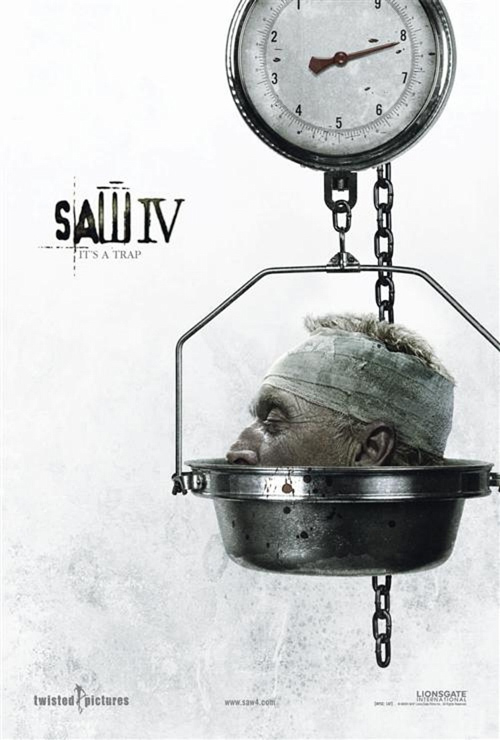
Saw Week: Saw 3D

Maybe Saw 3D was inevitably going to be a disappointment. It's the final instalment, and so needs to wrap up the entire franchise in a satisfying way, while showcasing plenty of new and elaborate traps ... and it's in 3D. It's a lot to pack into one movie, and ultimately, it doesn't really work. Which is such a shame, because there are parts of it that are really promising, but it just doesn't quite deliver.

The main problem is that it introduces too many new elements when, really, it needed to spend its time and effort tying up existing loose ends. We open on a trap, but a trap unlike any we've ever seen before: instead of being hidden away in a grimy basement somewhere, this trap is in a shop window, on a busy street, in broad daylight. Two men are chained to a workbench with three circular saw blades on it, and suspended above them is a woman: apparently she'd been cheating on one of them with the other, or something, it's not quite clear. Billy the puppet tricycles in to tell them that only two of them can possibly escape this trap: either they push the saws all to one side and murder one of the men, or they leave them in the middle, and let the woman perish. There's something particularly ugly about this trap, a hint of misogyny that hadn't really been present in the franchise before. But what's worse about this trap is that it doesn't tie into the rest of the film at all. Is this the work of John, or Hoffman? Who are these people, and why are they relevant? At what point in time is this happening? It doesn't matter, as it turns out. Not even slightly. So let's forget about that and get on with the story.

At the end of Saw VI, we saw Jill carry out John's final instructions by putting the reverse bear trap on Hoffman's head and locking him in a room, supposedly to perish without a hope of survival. But Hoffman did survive, albeit with a nasty facial wound. Saw 3D picks up from there, with a panicked Jill fleeing the scene as Hoffman chases her down. There's an obvious Halloween reference in this sequence, and that pretty much sets the tone for the rest of Hoffman's storyline. He's become a stalk'n'slash killer, a Michael Myers/Jason Voorhees character, walking slowly but inevitably towards his victims ... and killing them with a knife. There's none of Jigsaw's characteristic twisted morality to this: Hoffman's on a killing spree, and there's no subtlety to his methods at all.

While the previous films were complex, this one's just messy. There are at least two new stories running simultaneously here: there's a police plot, where Hoffman takes his revenge on Gibson, an internal affairs officer who previously turned Hoffman in for brutality, and there's a maze trap, where fake Jigsaw "survivor" Bobby Dagen must try to rescue his publicity team and his wife by actually going through some of the things he's become famous for claiming to. This trap's actually quite clever, but it's overly elaborate: Dagen is being punished for lying, for turning himself into a celebrity by pretending to have overcome a Jigsaw trap, and so the various stages in his maze are labelled with the steps from his self-help book, S.U.R.V.I.V.E. (Start your live anew, understand your problems, redefine your priorities, verify your self-worth through commitment, ignore your detractors, value your loved ones, and embrace every day as if it were your last.) That's further complicated by the addition of the themes of the three wise monkeys: see no evil, hear no evil, speak no evil. And while Hoffman's trying to force Gibson to hand over Jill, he's also setting up some elaborate traps at various significant locations from his own past. There's a hell of a lot going on here.

The twist that slightly unravels some of this tangle is that there's yet another Jigsaw accomplice to be unmasked: and, if you've seen any of the publicity for this movie, this is hardly a spoiler. It's Dr Lawrence Gordon. After he dragged himself out of the bathroom at the end of the first movie, Jigsaw took him in, built him a prosthetic foot, and brought him into the rapidly growing cult of Jigsaw. So all those incredibly intricate, surgical elements in many of the previous traps? That was Gordon's work. I'd like this twist a lot more if I didn't know Cary Elwes was returning; it would've been excellent if we hadn't seen him until right at the end, but he's been way too prominent in the publicity campaign for this twist to hold any real shock value.

So, while Gordon's running a trap for Dagen, Hoffman's leading Gibson around by the nose, and Jill is ... mostly just running away from Hoffman. Saw 3D commits one of the most obnoxious cinematic tricks when it gives us a dream sequence fakeout: while all of the previous films have tried to mislead and trick the audience in various ways, none of them have done it in such an obvious, clichéd and tired way. (Plus, in the dream sequence Jill is inexplicably wearing very little clothing, and an awful lot of lip gloss: really, guys? Really?) I think I just expected more.

There are lots of opportunities to do interesting things in this movie: Dagen's support groups for Jigsaw survivors are the perfect opportunity to give fans a little continuity porn by bringing back everyone who'd previously survived a trap, and while there were a couple of familiar faces back (Tara, Addy and Simone from Saw VI, and Mallick from Saw V), there was also a completely new trap and survivor thrown into the mix, which ... what? When was that supposed to have happened? It would've been better to stick to existing survivors, as few of them as there are. And the trailers for Saw 3D hinted that the audience would be implicated this time, which was really the only way to make sense of the opening trap. I expected some element of accusation - an invitation to consider what's wrong with me, personally, that I want to watch these movies? - but there was nothing.

Another major issue with Saw 3D is the relative lack of Tobin Bell. I know. John Kramer's been dead since Saw III, so continually bringing him back is getting a little tired. But we only got two new scenes with him this time round, and the film really suffered from his absence. Saw 3D focuses on Hoffman, a relative newcomer to the mythos, and all the new characters, even sidelining Jill Tuck in favour of bloody Gibson. (Chad Donella is my new least favourite Saw actor. He's terrible.) Jill's been lurking in the background for three movies now, and this was the filmmakers' last chance to really do something interesting with her, but they didn't. After their rehabilitation of Amanda in Saw VI, I really had faith that they'd give us some much needed insight into Jill, but sadly not.

I'm being overly negative now, I know. Saw 3D isn't terrible (it's certainly not as gutwrenchingly awful as Hostel Part II; it's more disappointing in the way that The Wire season 5 is disappointing). It's entertaining enough: it's camp, occasionally funny, and frequently disgusting. It's watchable. It's just not the high note I thought the franchise was going to go out on. This week has been an interesting experiment, though, and even taking the disappointing final instalment into account, I still hold the Saw franchise in far higher regard than I did even a week ago. I'm especially excited to see what creators James Wan and Leigh Whannell will do next.

Saw Week: Part VI

I think Saw VI is my favourite. Finally, everything makes sense (well, almost everything); the main story is just as engaging as the mythology stuff – and that gets an added dimension that retroactively improves the earlier movies – and it even has a serious political point to make. The editing is less distractingly awful, and the writing is as strong as in the previous two. It’s … really, really good.

That, or watching this many Saw movies in such a short space of time has utterly destroyed my brain, but I think it’s just good.

Saw VI’s centrepiece is another big maze trap, like the ones in Saw III and V. William Easton, a health insurance executive at Umbrella Health (that’s gotta be a Resident Evil reference, surely?) is an awful, smug man whose algorithm for determining individuals’ health risks has meant the death of countless people – including, indirectly, John Kramer. Jigsaw met Easton at a party (and let’s just take a moment to imagine what it would be like to get into a drunken conversation with him at a party, shall we? Urghhhhh) but he also had health insurance with Umbrella, who turned down his desperate request to be part of a Norwegian trial for an experimental cancer treatment. Tobin Bell does some amazing work in these flashback scenes; I particularly liked his “Pirahna!” non sequitur.

Anyway, Easton is a pretty nasty piece of work, which makes rooting for him almost impossible. Luckily, Saw VI’s traps are designed in a particularly cruel way: each of them requires him to choose between several people, letting some die and others live. Jigsaw wants to show him that no mathematical equation can truly measure the value of a human life, and Easton learns the lesson pretty quickly, choosing to save a middle-aged housewife over a young, healthy but unattached file clerk. These traps do sort of make a mockery of Jigsaw’s idea that everyone should get the chance to make a choice between life and death for themselves, since in several of the traps – particularly the carousel – not everyone can survive, no matter what. That’s the first time that’s happened, since in all of Jigsaw’s previous traps (not Amanda’s rigged ones) there’s always been the possibility that everyone can survive. But since all of these people are Easton’s employees, mostly his most heartless favourites who spend their working lives trying to find reasons to deny people the healthcare they so desperately need, it’s difficult to feel too much sympathy for them. And since this is Jigsaw’s final game, we’ll just have to cut him a bit of slack.

At the end of William’s maze, there are two cages: one containing Pamela Jenkins, a journalist we briefly glimpsed at a press conference in Saw V, and the other Tara and her teenaged son Brent. Without spoiling the twist too much, the end of Saw VI is another exercise in showing us not to make assumptions, ever. It’s kind of similar to the twist at the end of Saw III, really, but even more effectively executed.

Outside the trap, the police are closing in on Hoffman. Special Agent Perez, Strahm’s partner, turns out to have survived the injuries she suffered back in Saw IV, and she doesn’t believe that Strahm was Jigsaw’s accomplice. The tape Hoffman made in his first trap (the unwinnable pendulum game) is being analysed by a techie who unscrambles the distortion on the voice and reveals … Hoffman! Sadly, he’s in the room when that happens, and wastes no time in killing Perez for real, along with Erickson and the hapless tech. (A particularly nice touch: the soundbite that’s being unscrambled is “right now you’re feeling helpless”, and it plays over and over again during the scene where Perez confronts Hoffman. It’s maybe a little heavy-handed, but at this point, it really works.)

Revelation is piled on top of revelation as the final pieces of the story start to slot into place: Jill Tuck has been in on Jigsaw’s schemes since at least Saw III, if not earlier; Hoffman and Amanda were always jealous of one another and constantly jockeyed for position in Jigsaw’s affections; and most devastatingly, it emerges that Amanda was with Cecil, the junkie who caused Jill to miscarry Jigsaw’s child, on that fateful night - and Hoffman used that information to blackmail her, forcing her into failing her final test in Saw III. That last revelation at least partially redeems Amanda, changing the franchise’s treatment of her; she wasn’t just stupid after all, she was just a woman whose life took a really, really bad turn. Her desperation for John’s approval was her undoing, finally, but it wasn’t just because she was an idiot, or evil. Saw VI makes her more tragic, but also more sympathetic. It feels like a more dignified ending for her character than the previous one, and I’m really glad it happened.

It’s interesting: over the last couple of films, the new writing team have created a weird nuclear family for Jigsaw where Jill and John are the parents and Mark and Amanda are the squabbling kids. It’s perverse and twisted and … weirdly moving. Like any long running horror franchise, the villain eventually becomes the point, the one consistent element through all the films that, despite their undeniably evil intentions, the audience can’t help but sympathise with, at least a little bit. No-one remembers the eighth person Freddy Kruger murdered, or who Jason kills in Friday the 13th Part 5: A New Beginning, but Freddy and Jason are indelibly burned into our brains. Jigsaw slots effortlessly into the canon, but he’s exponentially more nuanced than any of the other mass murdering horror icons out there. We can’t entirely identify with him, or condone his actions fully, but there’s a sense there that, on some level, what he’s doing makes sense. It’s vigilante justice that he dispenses, but it’s not madness without method.

The final moments of Saw VI bode well for Saw VII: as Hoffman completes Jigsaw’s final game, he finds himself thrown into his own test, as Jill carries out the final instruction John left for her. Will he pass or fail the test? What’s the lesson Jigsaw needs him to learn – and will he learn it, or will he ignore it like so many of the other things John tried to teach him?

The attention to detail is probably my favourite thing about Saw VI, and it’s what gives me hope for Saw VII. There’s a particularly jaw-dropping bit of coffee cup continuity in Saw VI that’s so nerdy I wanted to stand and applaud, and the tiny, almost insignificant detail about Hoffman using an inferior kind of blade in Saw V that leads to his undoing in Saw VI is bloody beautiful. I’m simultaneously really excited to see Saw VII/3D, and terrified. I want it to be a fitting end to this franchise that I’ve somehow, unexpectedly, come to really love; I’m afraid that it’ll get too caught up with doing crazy 3D stunts to deliver the in-depth character exploration I crave. 3D has the same writing team and director as VI, which I’m hoping means it’ll be as good. Oh, please let it be as good.

Saw Week: Part V

Unsurprisingly, Saw V opens with a trap. A convicted murderer, who escaped a life sentence on a technicality, is chained to a table beneath a swinging blade. A slightly strange Billy tape tells him that in order to stop the pendulum from slicing him in half, he must crush his hands in vices – but when he does, nothing happens. The pendulum continues to descend, slicing him in half. Although it looked like a Jigsaw trap, it wasn’t: it was the work of Detective Mark Hoffman, and it took place several years ago. Saw V is about to significantly rewrite Saw history, and in a shockingly skillful way.

Since the first one, the Saw movies have been teaching us to be careful with the assumptions we make about what we’re seeing: people aren’t who they seem, and things may not be happening the way we think they are. Jigsaw’s ex wife, Jill Tuck, even explicitly tells us, more than once, not to take anything for granted: “John’s life defies chronology and linear description”, she says in Saw IV. That’s only going to seem more significant as things progress. Because it turns out that everything we thought we knew wasn’t quite true.

The action of V picks up at the end of III. Special Agent Strahm finds Jigsaw’s lair just as Jeff murders Jigsaw, and shoots him … but soon finds himself in a trap of his own, a box filled with water where the only way to survive is to punch a hole in his trachea with a helpfully supplied tube. Ouch. He does survive, though, as backup arrives just in time to see a soggy Hoffman carrying Jeff’s daughter to safety. Hoffman is lauded as a hero; Strahm is taken off the case for forging ahead without backup (and, sensibly, because he obviously needs some time to recover from his ordeal). Like everyone else who ever comes into contact with Jigsaw though, Strahm is obsessed, and no orders could ever really take him off the case.

Finally, a good 20 minutes in, the movie’s main trap is revealed: six people are chained by their necks to a winch, with the keys to their collars in glass boxes in front of them. But by struggling towards the boxes, they pull one another’s shackles tighter – and there are nasty blades behind each of their heads. Jigsaw’s video tells them that the reason they’re there is that they’ve all squandered advantages of birth by selfishness, and the only way to win is to work together. Naturally, they don’t listen, and as they progress through the maze, each trap kills another one of them, so that, at the finale, there are only two of them left. The twist? Co-operation was the only way to win, and by killing each other, they’ve thrown away their chance to survive. (Or, maybe: it’s not clear whether the two final test subjects actually die or not, though it doesn’t look good.)

That’s not the interesting bit, though. What's interesting about Saw V is the way the stories of Detective Lieutenant Mark Hoffman and Jigsaw’s ex wife Jill Tuck unfold. See, it turns out that Amanda wasn’t Jigsaw’s only accomplice – she wasn’t even his first. Hoffman created the pendulum trap to punish someone he thought had escaped justice, the man who murdered his sister. But because he wasn’t really on board with Jigsaw’s “everyone deserves a chance to chop bits of themselves off to discover their purpose in life” manifesto, he made an unwinnable game, and Jigsaw wasn’t impressed. He kidnapped Hoffman, forced him through a game of his own, and then basically adopted him. Hoffman was there from the beginning, supplying Jigsaw with the police records to select his victims and helping him build the traps. Hoffman is instrumental throughout; every time in a previous movie where something seemed like too much physical exertion for a terminally ill cancer patient to perform, it’s because Hoffman was doing it. Every time Jigsaw seemed to be in more than one place at the same time, it was Hoffman helping him. And now that John Kramer is dead, it’s down to Hoffman to finish Jigsaw’s final games – including trapping Agent Strahm and framing him as Jigsaw’s accomplice in the process. It’s breathtakingly daring, the way he pulls it off, and Strahm’s end is one of the franchise’s nastiest moments.

Stylewise, Saw V is littered with Argento references, but they’re far more subtly integrated than the franchise’s earlier horror references (e.g. in Saw II, Jigsaw directs Det Matthews to “the last house on the left”). The pendulum trap is straight out of The Black Cat, and the close-ups on Hoffman’s black leather gloves recall … well, most Argento films, really, but neither of these things seem particularly obtrusive in context. Director David Hackl doesn’t bother with Bousman’s obnoxious green and yellow palette, instead going for a more common teal-and-orange colour scheme for most of the movie, and the quick cutting has calmed down considerably. So far, Saw V is probably the best photographed film of the series, and the cleverness of the writing is astounding.

Honestly, I expected to be flagging by the time I got this far; I usually find it an uphill battle to get beyond the third movie in any horror franchise, because by most franchises have degenerated into exercises in making money off established names. But after Saw V, I was excited to revisit Saw VI … and even more excited to see Saw 3D (or Saw VII, as I may start calling it, in defiance of its actual, confusingly numbered title).

Saw Week: Part IV

Saw IV opens with John Kramer's naked corpse lying on an autopsy table. Just in case there was any doubt that he really did die at the end of Saw III, the film spends a lot of time with his dead body as it's dissected. Piece by piece, Jigsaw's body is taken apart. But the games aren't over yet. Not by a long shot.

Like Saw III, Saw IV is better than I remembered, but it's also massively flawed, like all the Saw movies. The first trap in Saw IV is utterly nonsensical: two men are chained together, their chains attached to a crank. One man has his eyes sewn shut, the other his mouth. Soon, the crank begins to turn, and apparently both of them perish. There's no handy tape to explain to us who these men are, or what they did to deserve their predicament. It's very, very gory, and very, very badly edited. All of the Saw films are fond of the rapidfire, epilepsy-inducing montages, but Saw IV is actively difficult to watch because of the nauseating way the camera moves. The colours look even more exaggerated, too, to the point where some scenes almost look like they're in greyscale. Bleurghhh.

It takes a little while for Saw IV's characters to emerge. Once again the police aren't just investigating the murders, they're actively involved. The only cop left from the original investigation, Rigg, is at the heart of this movie: because everyone around him has been murdered, he's become obsessed with the case, to the point that it's destroying his personal relationships. Unfortunately, because he's the only one left, he's also the prime suspect. FBI agents Strahm and Perez have been brought in to investigate, and the complexity of some of Saw III's traps has tipped them off to the existence of a second accomplice. Someone else was helping Jigsaw, and all the signs point to Rigg. When he discovers that Detective Matthews is still alive (while poor Kerry isn't!) Rigg has to submit to Jigsaw's tests to save him ... but unfortunately for Matthews, the lesson Jigsaw wants to teach Rigg is that it's impossible to save everyone.

Saw IV sits kind of strangely alongside Saw III. In III, Jeff had to put aside his personal grudges to save the lives of some pretty terrible people. In IV, Rigg must set aside his personal saviour complex to allow people to try to save themselves - or, if they can't, he needs to learn to let them die, and accept that he can't save everyone. Rigg has to actually put some people into their traps, though, and the film flirts with the idea of setting him up as Jigsaw's accomplice - though we've already seen that Jigsaw often uses people to do the physical labour that he can't manage, and has done ever since he made Zep in the first movie kidnap Dr Gordon's wife and child. (Actually, that might make the whole idea of a second accomplice nonsensical, because there will always be someone Jigsaw can coerce into doing his bidding, even if they aren't wannabes like Amanda -- but there is a second accomplice, so let's not think too hard about that.)

Ultimately, just like virtually everyone else before him, Rigg will fail his test and doom various other people to death in the process. What's more interesting about Saw IV, though, is the sizeable chunk of Jigsaw backstory it offers us. For one thing: Jigsaw had a wife. He nearly had a child, too, before a drug addict accidentally caused his wife to miscarry, and set in motion the whole Saw thing. That addict, Cecil, was the first person to be tested by a Jigsaw trap, the first time John had used his engineering skills to create torture devices. The origin of the pig head mask is also explained (though it's ... still kinda random) as well as the origin of the Billy doll. Everything that had previously been a mystery (or just a cool image without any explanation) gets explained in Saw IV, and unlike the awkward, stupid backstories that later sequels offered horror movie villains like Freddy and Jason, Jigsaw's backstory resonates. He's a very human kind of monster, and while much of his philosophising doesn't really hold water, it does make sense to him. His motivations suddenly come into focus; he's actually a cohesive character. This feels like a significant revelation, somehow.

Saw IV is the first Saw movie not to be written by Leigh Whannell (though it is still directed by Darren Lyn Bousman, which explains why it looks terrible) and it seems like the new writing team really has a handle on this stuff. It'll be interesting to see what they do with the Hoffman character over the next couple of movies, and whether they can create a more worthy successor to Jigsaw than Amanda turned out to be.

Saw Week: Part III

Last time I watched Saw III, I hated it. This time, I … actually rather enjoyed it. I think there are several reasons for my different reaction this time, but it all boils down to context. Since Saw III was released, horror movies have become even more gory and even more incoherent. At the time, Saw III seemed offensively badly structured, filled with pointless torture and nastiness. Now? It seems almost tame. Also, when I saw Saw III at the cinema, it’d been a year since I’d seen Saw II; this time, I’ve watched Saw and Saw II over the last two days, and I’ve already seen V and VI, so the character development seemed a lot better thought through. In particular, I enjoyed seeing Det. Hoffman lurking creepily in the background at the beginning … but I’m getting ahead of myself.

In Saw III, Jigsaw tests three different people in a series of interlinked tests: Jeff, a grieving father whose desire for vengeance on the man who accidentally killed his son is preventing him from living his life; Lynn, a doctor who’s been sleepwalking through her career, spending more time with dead and dying people than her own family; and Amanda, whose efforts to help Jigsaw have become weirdly twisted. While Jeff fights his way through a maze of people he hates and has to learn forgiveness, Lynn must work to keep Jigsaw alive, or risk losing her own life in the process. And Amanda? Well, she has to learn what Jigsaw’s methods are really all about: according to him, it’s all about giving people choices and forcing them to appreciate their lives more fully. It’s a warped philosophy to begin with, and Jigsaw’s tests are rarely fair anyway, but through a series of flashbacks, we see that Amanda has taken it upon herself to murder all the test subjects who survived their trials anyway, leaving herself as the sole survivor of Jigsaw’s games.

Saw III doesn’t really work properly as a standalone movie. It’s not structured well enough, and concerns itself mainly with explaining what happened behind the scenes of the previous movies as well as setting things up for those that’ll follow, and as a result the main narrative suffers from underdevelopment. Jeff is ultimately kind of pointless, and the traps he has to rescue people from aren’t very inspired. The first time I watched it, this meant I considered the film a failure. But this time, having spent time with some of these characters, it worked a lot better. Det Kerry’s fate seemed genuinely upsetting, having had her around for two movies, and Jigsaw’s final trap for Jeff is really rather nasty.

In fact, Saw III ends on just about the most downbeat note imaginable. Jeff fails his test. Lynn passes, but then Amanda fails it for her. And Amanda fails her test. Adam from Saw and Eric Mathews from Saw II are brought back and tortured some more; Adam is killed off. At the end of the movie, almost everyone we know from the previous movies is dead or dying. The body count in Saw III is sky high: Amanda’s unwinnable traps finish off several victims, Jeff fails to save anyone from his maze, including himself, and Jigsaw and Amanda are also killed. None of Jigsaw’s lessons have been learned, so there’s not even that perverted silver lining to cling to; really, Jigsaw turns out to be a really, really bad teacher. His protégé completely fails him, on every level: Amanda betrays him by going behind his back to kill people; she secretly self-harms, one of the things that led Jigsaw to test her in the first place; and before she dies, she denounces him, shouting “Nobody changes, it’s all a lie!” and “I’m just a pawn in your stupid games.”

It’s almost a shame to say goodbye to Amanda, in the same way it’s a shame to say goodbye to Kerry. Both of them felt like interesting characters who weren’t quite developed enough – Kerry more than Amanda, since the more screentime they gave Amanda, the more ridiculous she seemed. And that’s a shame, too. As the first person to survive a Jigsaw trap, she was in a unique position, and she was the only possible example he, or we, could point to to show that his techniques were effective. If Amanda lived through a Jigsaw trap and found a renewed enthusiasm for life, changing her junkie ways and doing something worthwhile with her life, then there’d be some fascinating ambiguity there; she’d be a powerful argument that Jigsaw isn’t just a psychopathic murderer, but some kind of ultra-violent vigilante. (okay, it wouldn’t be a great argument, but it’d be something). Instead, Amanda attaches herself, like a baby duck imprinting on a cat instead of its mother, to Jigsaw, and becomes his accomplice. She helps him kidnap people, helps him devise and build his traps, and guides people to their doom inside the poisoned house in Saw II. Which, if she really had changed her attitude to life, would make sense; she could argue that she’s helping other people come to the same realization she’d had.

But no. No, poor, stupid Amanda doesn’t get Jigsaw’s masterplan at all. She’s just a nasty piece of work who enjoys inflicting suffering on people she doesn’t like, including Lynn. She spends most of Saw III weeping uncontrollably at the prospect of losing John – someone who views her emotions as a weakness. It’s a disturbing, twisted relationship the two of them have, and surely even she couldn’t really consider herself his equal. On second thought, maybe it’s better that she doesn’t live to see another sequel (except, inevitably, in flashbacks). Saw III took away her reason for existing when it introduced Detective Hoffman.

Kerry, on the other hand, I’ll truly mourn. Only one of Amanda’s cheating, unwinnable traps could have conquered Kerry, because Kerry learned the rules early. She figured out the rules: do what Jigsaw tells you, and you’ll live. Try to outwit him, and you’ll lose, because Jigsaw always has another trap up his sleeve. Unlike Amanda, though, Kerry was a force for good, not evil; and, so, inevitably, she got killed. Of the original investigating team, only Det Rigg remains.
Bring on Saw IV!

Saw Week: Part II

Well, that didn't take long. After being strangely impressed with the first Saw movie, I found that Saw II is just as bad as I remembered.

It opens with a trap: a police informant wakes up in a room with a kind of variant on the bear trap on his head. But while last time, Amanda had to cut her key out of someone else's body to win her freedom, this guy needs to retrieve his key from behind his own eye. The editing goes crazy as he attempts to do so, and the lighting is garish yellow and green, a colour scheme the film won't let go of for the rest of its runtime. The soundtrack has some quiet shrieks built into it, so as our nameless snitch takes a razor to his own face, the music screams for him. It's already far more extreme and gory than the first Saw movie, but sadly, that extra edge comes at a price. Saw II is nowhere near so clever or well written as the first one.

The main story, in this case, is about Detective Eric Matthews (played, amazingly, by Donnie Wahlberg, who never quite seems comfortable unless he's fiddling with a cigarette). Jigsaw has kidnapped his teenage son and locked him in a house with a selection of decidedly unsavoury characters, including - dun dun dun! - Amanda herself. Again, it's tough to watch this movie without remembering what's to come, and knowing the end of the film killed pretty much all the tension for me. While the criminals inside the house battle against time (and nerve gas) to win their freedom through a series of increasingly nasty traps, Det. Matthews is asked to just sit and talk to Jigsaw, watching what's going on in the house via a series of monitors and letting the timer in Jigsaw's lair tick down to zero.

Since it's pretty well established that Matthews is a dirty cop who gets his results by planting evidence and beating up witnesses, he's incapable of doing so, and ends up walking into his own trap. When the timer hits zero, he's chained to a wall in the bathroom from the first movie, while a safe in Jigsaw's house pops open to reveal that Matthews Jnr was "safe" all along. The monitors weren't showing a live stream at all, but rather events that happened several hours ago. It's a fairly neat trick that's spoiled by the lack of action outside the house: all Jigsaw wants is to sit and chat, spouting off about how most people don't deserve to live because they don't appreciate their lives (and, bizarrely, recounting an accident he had after he was diagnosed with cancer where he drove his car off a cliff and survived despite being impaled on a pole). And that's spoiled by the fact that already, Jigsaw doesn't really make sense. According to him, he never really kills anyone, he lets them make a choice. But in Saw II, most of the choices aren't choices at all.

The trap that I really remembered from this movie is the pit of needles. It's a wonderfully nasty idea, but it's sort of nonsensical. The first few traps are labelled with the names of the people in the house (Obi, apparently pronounced "Abi", and Xavier, pronounced like Professor Xavier; either Whannell or Bousman is apparently a massive nerd). The traps are supposed to relate to their particular weaknesses, like the way the informant at the beginning is forced to destroy his eye, or the way the wristcutter from the first movie has to fight through razorwire. But this time round, they don't really work. Who's supposed to go into the oven, and why? What's the deal with the wrist trap that Addison gets herself caught in? The idea that the only way through the maze is co-operation is one that'll recur in the later Saw movies, but it's not properly developed here.

What's weird is that I remember there being a lot more explanation and characterisation in this movie than there actually is. The film doesn't explain, for instance, why most of the characters were in jail; it establishes that that's what they have in common, but not why, beyond the fact that they were framed by Matthews. It's also not really clear why Amanda decides to put herself in harm's way; she's almost killed several times in the course of the film, and for no real benefit. She reveals herself at the end as Jigsaw's accomplice, but her only motivation in getting involved is, apparently, to trick the audience watching at home. Which is a bit silly, really.

The one bonus is that the acting isn't quite as bad in Saw II as it was in Saw. The script, unfortunately, is worse, though, and the concept is messier. It doesn't bode well for Saw III.

Saw Week: Part I

The final Saw movie is released this Friday, and to mark the, um, occasion, I'm going to watch the six previous instalments this week, and then go and see the final one on the weekend. (It's gonna be a long week.) The mythology has become so elaborate and tangled that I want to be able to see Saw 3D in context; whether you love or hate the franchise, it's become an institution, as influential as any of the other long-running franchises, and I feel a strange obligation to see it out properly.

The first one is both better and worse than I remember it being. The main setup - two men are chained up in a disgusting underground bathroom somewhere and have to figure out a way to escape before their time runs out - is pretty effective, and the script is full of twists and turns. Initially, Dr Lawrence Gordon seems like the villain: he acts suspicious and creepy and generally seems like a complete asshole, but as the film progresses, it seems like the other man, Adam, has something to hide too. Through a series of flashbacks, we slowly start to piece things together. There's a sort-of serial killer on the loose who hates people wasting their lives and wants to force them to recognise their blessings via a series of elaborate and extremely violent traps; his habit of carving a jigsaw-shaped piece of skin out of his victims' bodies has led to the media dubbing him "Jigsaw". There's a creepy hospital orderly (played by Michael Emerson, aka Ben from Lost) who's got something to do with it; there's an obsessed ex-cop who's convinced Gordon is Jigsaw; and there's a corpse on the floor of the bathroom that might not be as dead as it seems...

Saw also introduces us to Amanda, a drug addict who finds a new purpose in life through her encounter with Jigsaw. She's only in a handful of scenes, and it's difficult to watch them without remembering everything that's to come. The Saw theme also makes its debut in this movie, sounding instantly iconic, as creepy and evocative as the Halloween theme, or Tubular Bells. The Saw mythology has grown so much since this movie that it's difficult to really see it for what it is, or what it was then; everything seems imbued with extra significance.

In 2004, Saw seemed like the scariest, most disgusting, most extreme film imaginable. I actually didn't see it in cinemas because I'd heard so much about the extreme torture in the movie, but now, looking back, it seems almost tame. There's not very much gore after all: and not counting the main chained-by-the-ankles trap at the centre of the film, we only see three of Jigsaw's elaborate mantraps. (There's the reverse beartrap, there's the room of razor wire, and there's a prototype of the drill chair that we'll see more of later.) All of them rely more on the audience's imagination than on showing too much too clearly (although Amanda pawing through a man's intestines to find the key to her trap is a little much). Saw does a lot with a little; Jigsaw's traps are horrifying because they play on your mind and make you wonder what you'd do if you had to face one of them, but there's very little actual torture going on. There's none of the prolonged suffering that will characterise some of the later movies in this series, or some of the later torture porn movies that cashed in on Saw's phenomenal success. And a lot of the scares (mostly to do with Gordon's wife and child, but also the sequence in Adam's apartment lit entirely by camera flash) really work. The writing and structure of Saw is a lot better than I think I ever gave it credit for.

But, and there had to be a but, the execution leaves a lot to be desired. Mainly, the acting is appalling. Cary Elwes, in particular, is awful. He's overly sinister to begin with, but it's when he's forced to show some emotion that everything falls apart. He's utterly unconvincing as a man afraid for his family; he's utterly unconvincing as a man afraid for his own life; and he's ... oh, he's just useless, really. Gordon's bizarre backstory, where he may or may not be having an affair with someone he works with, makes very little sense, and Elwes fails to sell any part of his emotional journey. Leigh Whannell isn't a particularly good actor, either (he demonstrates any kind of heightened emotion by getting really high-pitched) but he's passable, whereas Elwes almost ruins the film on more than one occasion by turning what should be a touching or frightening moment into squealing melodrama.

The editing, too, is horrible. The film's aesthetic is overdone now, but works nicely here; it's just the crazy quick-cutting that threatens to spoil it. There's a car chase near the end that consists of quick cuts between the two drivers' faces - it's presumably because car chases are difficult and expensive to shoot, but this weird cobbled together mess is just comical. The film is full of overly stylised quick cuts; it aims for slick but lands somewhere around "amateurish" instead. But it's forgiveable in a film as cheap and inventive as this one.

Saw is certainly a flawed film, and it's flawed in frustrating ways, because there's a fantastic idea at the heart of it, and lots of clever and creepy ideas packed into it. It could so easily have been brilliant, but instead it's just pretty good. Horror films have changed a lot since Saw's release, partly as a result of the success of Saw and Hostel, and it hasn't been for the better. It's difficult to see Saw with fresh eyes, without seeing the zillions of imitators that have used and reused every part of this movie. But if you can forget all that (and somehow ignore Elwes's inability to act) it's really pretty decent. I feel like I owe Saw an apology ... for now, anyway. At least until I get as far as Saw III.

Buried (2010)

The central conceit of Buried is daring, to say the least. Paul Conroy (Ryan Reynolds), a truck driver delivering supplies to a community centre in Iraq, is captured by insurgents (or terrorists, or someone) and buried alive in a box with only a mobile phone and a Zippo lighter for company. The entire film is set inside the box with Paul while he negotiates with his captors, his employers, and the head of a hostage rescue organisation. With such an unconventional premise, the movie could only ever be amazing or terrible.

And sadly, it’s terrible.

It starts off strongly, with a few minutes of complete darkness and silence before we hear Conroy’s laboured breathing. He finds his lighter and the inside of the crude wooden box is illuminated; using the end of a nail, he saws through the restraints on his wrists and removes his gag. Then a phone rings, down at the bottom of his makeshift coffin. What follows is 90-odd minutes of increasing ridiculousness.

Conroy calls 911 and finds the super-calm operator little help. He calls his family but only gets through to voicemail. He calls the State Department, calls his employers, calls everyone, and has a series of awkward, expository conversations with dead voiced people. The point, then, is that no-one cares about what’s going on out in Iraq; that the US military is pretty useless; and that big corporations are more interested in protecting themselves from bad publicity than looking after their employees. A conversation with his aged mother attempts to wring some pathos out of the proceedings; a subplot involving one of Conroy’s colleagues hammers home the fact that his captors mean business, in case the whole being-buried-alive-in-a-box thing wasn’t enough to convince us. Ryan Reynolds does an admirable job of trying to carry the movie – since he’s the only person we see for the entire film, everything rests on his reactions – but the script is too upsettingly awful for him to succeed.

It’s just not plausible that none of the people he speaks to would get even slightly emotional. There’s no urgency in any of their voices, so the outcome of the movie is a forgone conclusion from the very beginning. No-one seems to disbelieve him when he screams that he’s buried in a box in Iraq, despite being on a very clear mobile line to a phone operator in Ohio, but no-one seems to be interested either. The dialogue is awkward, stagey; the conversation Conroy has with Dan Brenner at the hostage rescue organisation about other hostages who have previously been rescued is like no conversation two human beings have had with one another, ever. And the editing is painfully amateurish. There’s a scene where the camera zooms ominously and distractingly in on Conroy’s face while he talks; later, there’s an upwards zoom where the camera moves further and further away from Paul’s prone body, wooden box walls on either side of him, until we’re a good 20ft above him … but somehow still inside the box, still in the dark, still penned in by that box which is now inexplicably, for onscreen effect, twenty times the size it was earlier. It’s a weird thing to do, destroying your audience’s suspension of disbelief – we know Ryan Reynolds isn’t really alone in a box, we know there’s a camera crew there and after this scene he’s gonna get out and stretch his legs, but for the purpose of watching the film, we choose to forget that. By /actually showing us/ something that couldn’t possibly exist in the film, the filmmakers throw the artificiality of it all in our faces, and for no good reason.

The problem is that, having come up with the concept for a movie that’s all about dialogue and claustrophobia, the writers weren’t up to delivering: they weren’t seem capable of writing that dialogue, nor holding the audience’s attention. Thus we’re treated to a scene in which Conroy suddenly discovers that there’s a snake /inside his trousers/ and, when it slithers out and hisses at him from the bottom of his coffin, he douses it in alcohol from his hip flask, then sets it on fire with his Zippo. The snake slithers out of a hole in the side of the box, never to be seen again – the snake, or the hole. Conroy doesn’t even seem to register it, and somehow, that scene makes the casting of Ryan Reynolds seem bizarre.

Conroy, we’re told, has less than $700 to his name, which is why he took this awful job driving a truck in Iraq. He’s not a soldier, and he’s not much of anything, really; he’s not particularly clever, not particularly interesting, and his only other distinguishing feature is that he has to take pills to ward off anxiety. He doesn’t try to break out of the box, and after the initial wriggling around to cut off the ties on his wrists, he doesn’t do anything except lie in the box and make phone calls. So why cast someone as famously muscular and athletic and attractive as Reynolds? It seems like it would have made more sense to cast someone who looked less capable; someone who didn’t look like they could punch their way through the crappy wooden box. (Alright, depending on how deeply he was buried, the weight of the sand on top of the box might have caused that effort to fail, but we know he’s not that deep because his phone still works.) Towards the end of the film, the box starts to collapse anyway, and Conroy still doesn’t try to get out, instead wasting his last few breaths on stupid conversations with his ex-employers.

Nothing about Buried really works. Conroy is drawn with the broadest of strokes (his mum’s ill! He’s got a young son! He takes anxiety pills!). The dialogue is stilted. The pacing of the film is off – it’s far too long for what it is – and there’s no structure to speak of. The awkward attempt at turning Conroy’s captors into sympathetic, if desperate, people rather than monstrous terrorists utterly fails. And the ending is brainmeltingly stupid. Come on. This is nonsense. This is satire for morons. It’s first draft, badly written, poorly conceived crap designed to give people without any political awareness something to talk about.

IMDB link

The Last Exorcism (2010)

The Last Exorcism is yet another in a long string of recent movies dressed up to look like cheap documentaries or found footage: the conceit here is that Rev Cotton Marcus, a preacher popular for his showmanship, wants to expose exorcism as the massive scam that it is. He's got a young son and is disturbed by the stories of children being killed mid-exorcism by the people supposedly trying to "save" them. So, with a small documentary crew in tow, he sets off to an isolated farm where the Sweetzer family is battling all kinds of demons, determined to show the world that exorcism is nonsense.


Of course, it all goes horribly wrong.

The first half an hour of The Last Exorcism works pretty well: one of the challenges for this kind of movie is setting up why things are being filmed, and Rev Marcus's motivations for wanting to get out of the exorcism game are believable enough. The point where it all starts to fall apart is when the crew arrive at the Sweetzer's farm, and the father of the family, Louis, tells him to turn off his camera. There are several minutes of argument in the film, including the screen fading to black for a little while, and a conversation we can't hear between Marcus and Louis Sweetzer being filmed from behind glass. But the film we're watching is supposed to be a documentary, and it's been edited - it's not continuous found footage like in Cloverfield, there are cuts and captions and music added in - so why has this scene been left in? It's awkward, and it's the first sign that the filmmakers haven't entirely got a handle on what exactly they're creating here. And it only gets worse as the film progresses.

The Last Exorcism is, at least, reasonably careful not to commit itself to any one explanation for the weirdness that's going on at the farm: Nell Sweetzer, the supposedly possessed girl, appears to be sweet and innocent, while her brother is sullen and obnoxious, and her father is a scarily over-protective religious zealot who drinks too much and, possibly, sexually abuses his daughter. The film offers us two explanations for all the violence and spookiness that's going on: either Nell is really possessed by a demon, or she's a damaged girl who's been unbalanced by the death of her mother, extreme isolation, religion, and abuse. Because the initial premise of the film is that Rev Marcus wants to prove that exorcism isn't real, though, it seems fairly reasonable to expect that the film will show us that sometimes, demons are real - otherwise, what's the point? In that case, The Last Exorcism would join the ranks of horror films where young girls are abused by their parents for their own good (and the good of everyone else) because they're evil/demonic/possessed, a trend that uncomfortably appropriates the hallmarks of abuse and justifies them. If the demon isn't real, then it's a sad story of a girl punished by her community for imaginary sins and mental illness in a way that feels too medieval to be happening in 2010, a condemnation of small town zealotry.

But the film can't seem to make up its mind, and rather than commit itself either way, it concocts an ending that makes gibberish of the whole endeavour. After conducting a second exorcism, during which Nell contorts herself into all sorts of painful positions (something that might have been a little more shocking if it wasn't used in the marketing campaign) it emerges that Nell is pregnant by a local boy, and the shame and fear of punishment from her puritanical father, combined with everything else she's had to go through, seems to explain her mental breakdown. A self-satisfied Marcus and crew prepare to leave town, but when they realise that Nell's story doesn't hold up, they decide to return to the farmhouse (instead of, at this point, calling the police, or some kind of social services) and ... it's difficult to explain what they find, it's so utterly nonsensical. When the crew get to the Sweetzer's farmhouse, they discover that the place is covered in pentagrams and other arcane symbols, daubed on the walls in blood. Outside, they discover some kind of Satanic ritual is in progress, with Nell screaming on an altar as she gives birth to something or other and Louis lashed to a pole. Among the hooded figures standing around the pyre is a local priest, who tosses the newborn baby into the fire. For a moment the film threatens to become The Wicker Man as Marcus musters what's left of his long-dead faith to break up the ritual. Brandishing a crucifix, he walks into the flames, a symbol we've already seen represented in Nell's primitive artwork. And the documentary crew, despite protesting numerous times about wanting to leave because things are getting too dangerous, hang around long enough to film all of this before finally, finally, turning tail and running, only to get murdered in the woods themselves.

And that's the end. It doesn't work. Nothing about the film works. Was Nell possessed? Who was the father of her baby - and why did the townsfolk kill it? An effective twist ending makes you reconsider everything else that happened in the film, viewing everything through the lens of the new information you've been given. The ending of The Last Exorcism is nonsense; it doesn't add anything, it actually makes the film even more incoherent. If Marcus and the crew were all killed that night, who put the documentary together? How did they get hold of the footage? And why did they edit it so badly? The structure of the film is a mess. If you're going to use sound as a plot element - Marcus rigs up speakers to emit demonic grunting during his fake exorcisms, Nell plays the recorder discordantly and creepily from inside her locked bedroom - then adding in extra sound cues during tense scenes ruins all of that. If you're going to try to make the film feel naturalistic, including moments where the camera is switched off and back on again, then you can't use quick cuts or multiple cameras to cover both sides of a conversation. If you're going to have your camera held by an actual character in the story (not that poor cameraman Daniel really got to have much in the way of characterisation or screentime) then you need to give them a convincing reason to keep filming when things get dangerous or difficult, and you can't use multiple angles on the same scene, or you destroy your audience's willing suspension of disbelief. It's just sloppy to mash up elements of traditional horror movie filmmaking with documentary making and figure no-one will notice - it's disrespectful to your audience. That faux documentary style gimmick is over-used already, and while The Last Exorcism initially seemed to have a pretty decent reason for employing it, it wasn't well thought through enough to work. The best thing about the movie is the acting, but while all the actors are great, they're let down by a weak script and a badly executed concept. Less of this kind of crap, please.

F (2010)

Every generation thinks the one after it is doing it wrong. The kids of today are always more irresponsible, more violent, less educated, and generally less civilised than the generation who went before them. Johannes Roberts’s F crystallises that attitude, with the added bonus that this time, the kids actually aren’t alright.

Robert Anderson is an English teacher whose life effectively fell apart when he was attacked by one of his students. He gave the kid a failing grade, handed out with a dollop of verbal abuse, and got a bloody nose for his troubles. When the school took the student’s side, suspending Anderson until the end of term and forbidding him to give out “F” grades anymore, Anderson lost his confidence – and, apparently, everything else. Separated from his wife and unable to keep control in the classroom, Anderson turns to drink. He’s paranoid, calling the police so regularly that they recognise his voice, and he’s one mistake away from getting the sack.

Anderson’s daughter, Kate, is a typical teenager: she rolls up her school skirt, smokes in the toilets, and sends text messages during class. She’s distanced herself from her father, leaving her mother to carry messages between them, and even in his classroom she barely acknowledges him. It’s a familiar situation; she’s not a bad kid, but she’s rebelling against his overly strict rules in every way she can, and the more he tries to rein her in, the further he pushes her away.

One winter evening, Anderson keeps Kate back after school, giving her a detention on spurious grounds – mostly just so that he can spend time with her – but even then, he can’t communicate with her. He confiscates her mobile phone, sparking yet another argument, but this time things go too far. His relationship with Kate – and with his wife – may never recover. The two of them are so effectively pushed apart from one another that they’re completely isolated when the killing starts.

The deserted school provides a great setting for some stalk ‘n’ slash action: it’s big enough that the few people who are still there are too far apart to hear or help one another, but connected enough that the killers can move from one area to another quickly and easily. There are plenty of places to hide, and, like any location that’s usually filled with people, an empty school is inherently creepy.

The killers are the embodiment of Anderson’s worst fears: youths in hoodies who have no respect for authority. There’s no apparent motive behind their killings, and none of the hoodies ever show their faces; whether they’re even human is up for debate. They move quickly and silently through the school, climbing the walls, running along shelves, hiding above eye level only to drop down and kill. The violence they perpetrate is random, and quick: they don’t linger over their victims, and they don’t appear to take any pleasure in their work. They just strike and kill, in a series of increasingly nasty ways. F holds back a lot of its gore; most of the killing is done off screen, with only sound effects or blood spatter to feed the audience’s imagination. The one moment in which we’re allowed to see what they’ve done to one of their victims, it’s shocking, almost incomprehensibly awful. These are some scary baddies.

The fact that the hoodies aren’t given names, faces, or motives makes them blanks onto which the audience can project their fears. They’re, literally, just hoodies; they’ve become dehumanised, not characters but symbols. There’s no need for them to have back stories or motives; just the fact that they’re wearing hoodies makes them frightening. And the relationship between Anderson and Kate makes us care: Anderson is far from being a hero, but F makes us feel for him, makes us experience his desperation to save Kate. To not to fuck up again. After all, the only reason she’s even in danger is because of him.

F is a film with almost no fat on its bones: there are only a few characters, even fewer who really matter, and it doesn’t linger over explanations. After the unrelenting tension of the previous scenes, the ending seems rather abrupt, but give it a moment: let it sink in. There’s maybe something slightly off with the pacing, but that ending seems to work better the further away you get from it. Downbeat, no-win endings are common among a certain strain of modern horror movies, and F couldn’t have ended any other way. This isn’t a gung ho revenge flick. F is a film about loss of control; a film about the breakdown of relationships; a film about the unbridgeable gap between one generation and the next. It’s a film about choices, and sometimes, there is no right answer.

IMDb link

Zombieland (2009)

You probably already got the memo, but zombies are cool now. A lot of the most painful hipster nonsense surrounding the undead can be blamed on Max Brooks, who wrote both the fake instructional Zombie Survival Guide and the novel World War Z. Probably some of the blame can also be laid on Zack Snyder's head, for directing the dire remake of Dawn of the Dead. And quite a lot of it attaches to Simon Pegg and Edgar Wright for the wonderful Shaun of the Dead. Whoever's fault it is, though, the fact remains that zombies are cool. Zombie-related merchandise is everywhere and, since zombie movies are virtually guaranteed successes, they're being cranked out at a rate of knots. The revival started in 2004 and, somehow, it hasn't ended yet.


But if there was any justice in the world, the release of Zombieland would mark the exact moment everyone realised how incredibly stale this genre has become. Because it's not a zombie movie, nor is it a horror movie. It's one of those sub-Apatow films about a neurotic misogynist nerd who, somehow, incredibly, ends up with a beautiful woman on his arm for no good reason. The zombies -- who, actually, aren't even zombies, despite the film's insistence on using that word constantly throughout -- are never a credible threat. They're just backdrop. They could be anything. They're just there because it's cool. Zombieland takes the most basic, superficial elements of zombie movies, and a stack of the most tired cliches, and jams them into a story about an awful manchild who never had any friends or understanding of how to relate to another human being eventually learns to get over himself. Sort of.

What's really difficult to work out is whether we're ever supposed to like or empathise with "Columbus". Given that he's the main character and also narrates most of the film, it'd be nice if he had some redeeming qualities, but he doesn't. In place of a character, he has a string of cliched quirks: he plays WoW, he doesn't like going out, he's a bit germphobic, he's scared of clowns, and he doesn't understand that "hot girls" are actually people. And he's the most fully developed character in the movie. Zombieland also gives us "Tallahassee", the obligatory hardman with a heart of goo and a sad backstory about a dead son we'll only bother to hear about for five minutes; "Witchita", the love interest for Columbus who, we're told, is smart and independent but barely acts like it; and "Little Rock", Witchita's kid sister who's just there to remark on how she doesn't get the cultural references everyone else insists on making.

(In case it's not blindingly obvious, I find it intensely irritating that the characters in Zombieland aren't given actual names, just places they're trying to get to. It's not cute.)

None of these characters really develop over the course of the movie. Columbus does a little bit, just enough to provide a sickening closing monologue on the nature of humanity, but that's no hero's journey. And he's no hero. His motivation for most of the film seems to be finding a girl who'll let him touch her, and that's when he can bring himself to stop referring to women as bitches. The film's low point is either when Columbus describes Witchita as "not your typical hot stuck-up bitch" or when she refers to the girls who didn't ask him to the dance in eighth grade as "those bitches," outraged that anyone could ever have found his awful, immature whinging anything less than irresistible. The film's tagline, "nut up or shut up", pretty much sums up the movie's attitude towards women. They're either evil or helpless and in need of rescue.

It's not the worst offender in the sexism stakes, but it's pretty bad. And since Zombieland doesn't have any redeeming qualities, it's hard to ignore. Structurally, the film is all over the place. It has no beginning-middle-end. It has no real conflict, since it utterly fails to ever put any of the characters in any kind of danger. It doesn't even have the good grace to be funny, although it tries desperately, with recurring "jokes" about Tallahassee's love for Twinkies, and the excruciatingly awful Bill Murray cameo. Nothing happens in this movie. It's difficult to summarise the plot, because there wasn't one. Some movies can make that work, but usually only when they have strong characters, relationships, and themes to play with instead. Zombieland has none of the above. It doesn't even have a solid central premise, because the "zombies" in the movie aren't zombies, and "Zombieland", which is used to refer to the post-apocalypse America, is a false conceit because the whole world is overrun with the infected.

The thing is, I wasn't even expecting it to be good. I was expecting it to be your typical post-2004 lazy zombie movie where forgettable characters battle the usual zombie horde and end up saving the day, somehow (or at least surviving to live another one). It's not even that. It's a horrible mess that uses the trappings of zombie movies to disguise an utter lack of ideas, story, or intelligence. It's a waste of time, life, and celluloid.